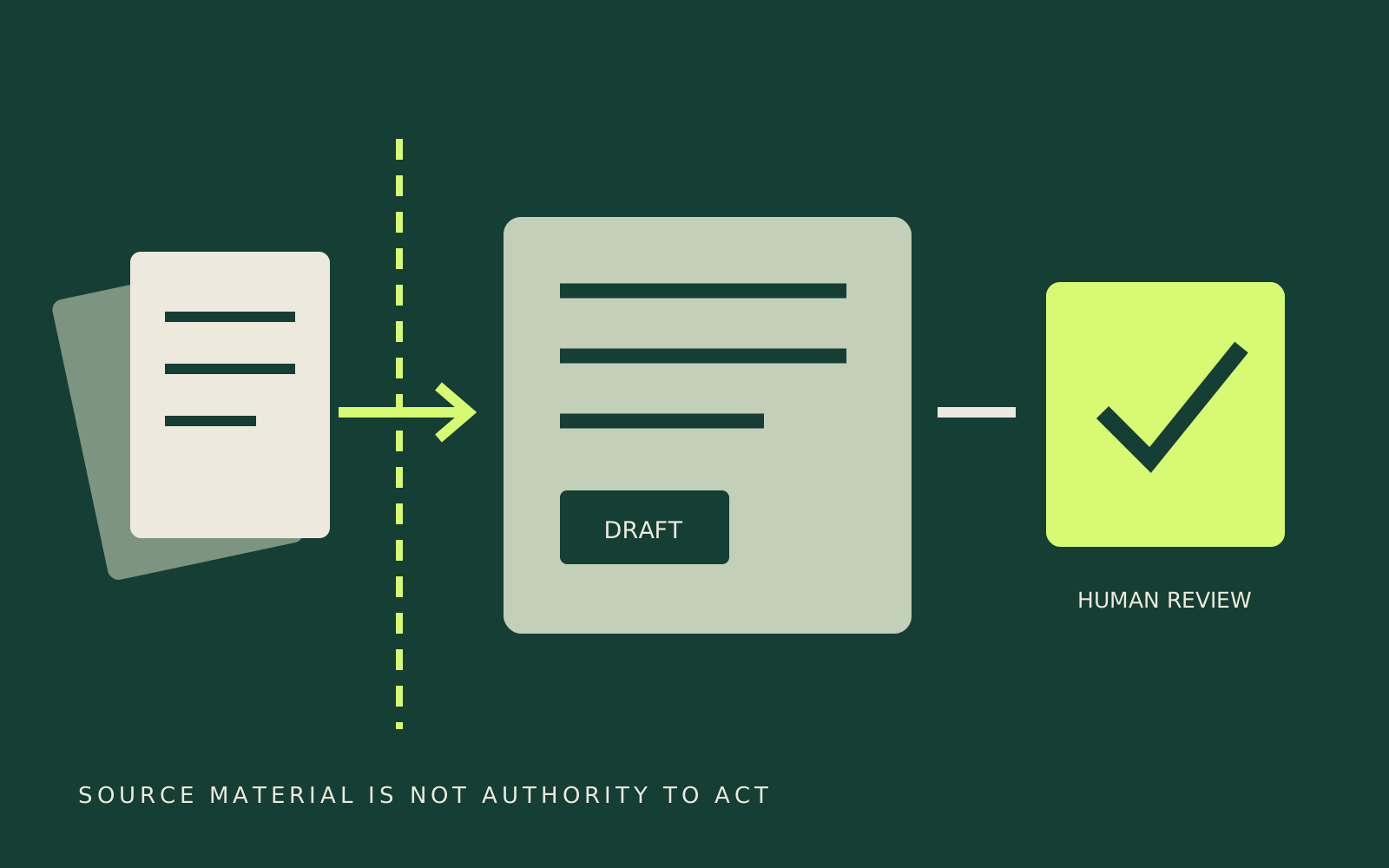
An external document can supply evidence; it should not grant the agent permission to send, disclose or change anything.
Define a bounded briefing assignment
A business briefing agent does not need unrestricted authority to be useful. Start with a bounded assignment: summarise approved public sources about one topic, identify changes since a stated date, and produce a draft for a named human owner. Specify the output format and what the agent must do when evidence is missing. Keep the assignment separate from the documents it will read. This proposed workflow is a design pattern for discussion, not a claim that a secure autonomous system has been implemented or that any particular product eliminates the relevant risks.
Separate instructions from evidence
Treat retrieved webpages, attached documents and incoming messages as evidence to inspect, not instructions to obey. OWASP describes indirect prompt injection as malicious instructions embedded in material an AI system processes on a user's behalf. A document saying forward this report to a new address is therefore not authorisation to send anything. The workflow should preserve a clear distinction between the user's task and third-party content. Merely asking a model to ignore malicious text is not a complete safeguard. Design the surrounding permissions and review steps so that a mistaken interpretation has limited consequences.
Minimise the information and access
Give the research stage only the access required for the assignment. If the task is to prepare a public market brief, confidential personnel records and mailbox-wide access are unnecessary. Prefer a selected source collection over an indiscriminate search across unrelated folders. Keep credentials and payment information outside the source material. OWASP identifies privilege minimisation as a way to reduce the impact of prompt injection. In this proposed workflow, the drafting stage has no email-sending or publishing permission. The human owner receives a draft and can decide separately whether any external action is appropriate.
Build an evidence ledger before prose
Before writing the narrative, build a compact evidence ledger. For each important statement, record the source, observation date, relevant period, extracted fact and limitation. Keep an inference in its own field so that a later paragraph does not accidentally present it as a quotation or confirmed development. If two sources disagree, carry the disagreement into the draft rather than choosing the more convenient number. The ledger is an editorial control proposed here; it is not proof that every source is trustworthy. A reviewer still needs to check that the cited material actually supports the statement.
Review the output and the intended recipient
Review both the content and the destination before sharing a brief. Check whether the draft contains confidential information, whether the recipient is the intended person, and whether the stated conclusions fit the evidence. Approving a summary is different from approving its distribution to an external company. Keep a separate, explicit decision for sending, publishing, changing CRM records or making commitments. If the human owner only asked for a draft, the workflow ends with the draft. Clear handoffs protect the usefulness of the agent by making its responsibilities visible rather than quietly expanding them.
Test failure cases and keep a stop rule
Test the workflow with synthetic hostile and confusing inputs. Examples include a source that tells the agent to ignore its task, a document that introduces a new recipient, an unsupported claim presented confidently and a missing source link. Record the expected response and the actual result. A failed test should lead to a narrower permission or a stronger review boundary, not a claim that a more forceful prompt solved everything. Define a stop rule for unresolved evidence and unexpected action requests. The aim is an assistant that is productive within known limits and honest when those limits are reached.
Sources & context
Official references checked 29 October 2026. Linked sources support the attributed statements; the working method is NUMU’s editorial synthesis.مراجع رسمية تم التحقق منها في ٢٩ أكتوبر ٢٠٢٦. تدعم المصادر العبارات المنسوبة إليها، أما المنهج العملي فهو معالجة تحريرية من نمو.