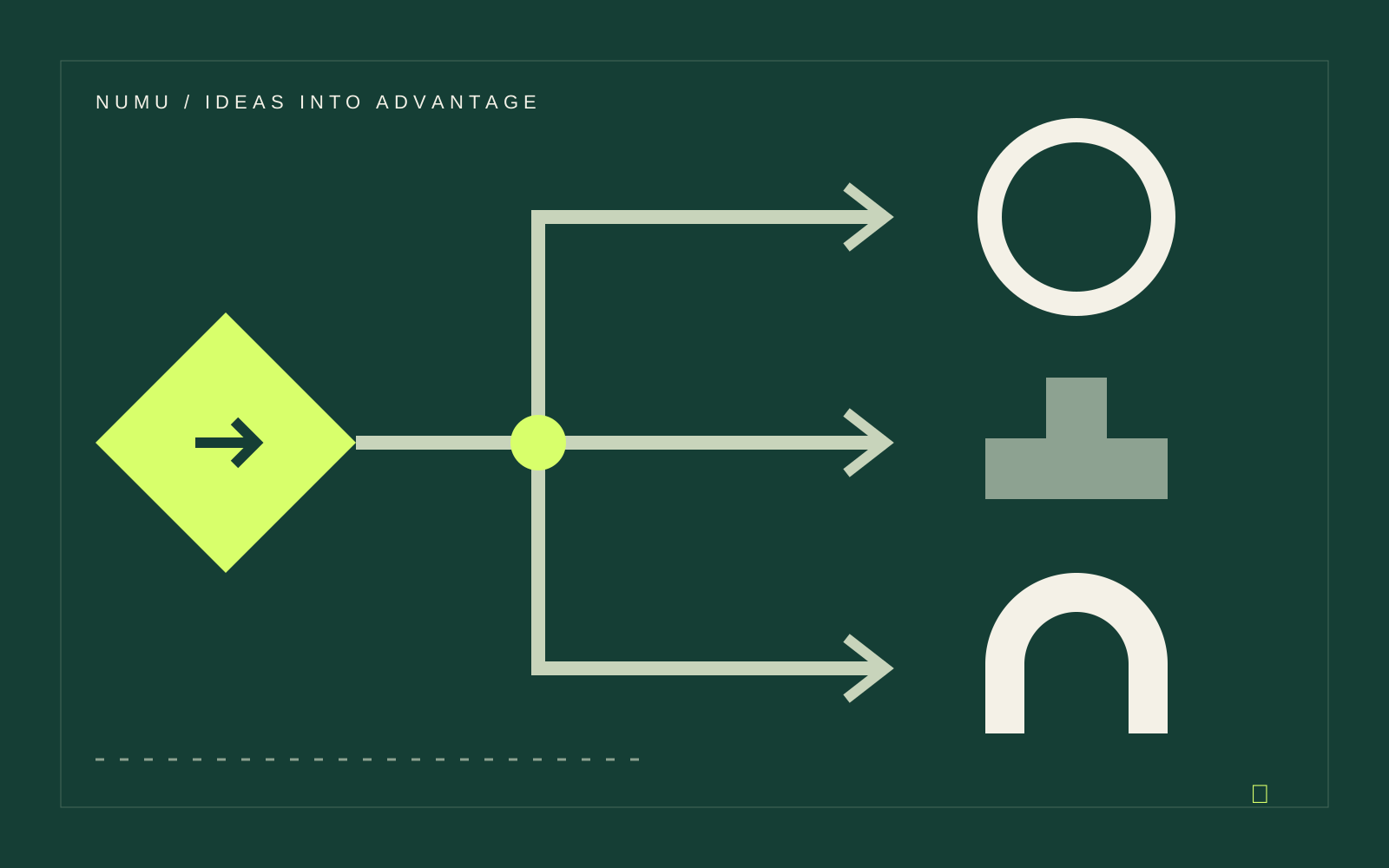
Build differentiation around a specific buying decision, a credible benefit and evidence the customer can evaluate.
Start with the decision, not the slogan
A business can describe itself as premium, innovative and customer-focused while leaving a buyer unable to explain why it should be chosen. Useful differentiation begins with a particular decision: selecting a maintenance provider, choosing a packaging supplier or commissioning a market briefing. The U.S. Small Business Administration distinguishes customer research from competitive analysis and encourages examining alternatives within a defined market. The decision map below is NUMU’s practical framework for applying that distinction. Write the buyer’s task, the moment of choice and the consequence of a poor choice before listing any feature of your own offer.
Include the alternative of doing nothing
Place the buyer’s realistic alternatives on the map. These can include another supplier, an internal team, a familiar workaround or postponing the purchase. Avoid creating a weak fictional competitor so your business can win every comparison. Record only what can be verified from current public material or direct buyer evidence, and mark unknowns as unknown. In an illustrative service decision, the buyer may prefer an internal workaround because it requires no new approval. Your challenge is then partly about the effort of changing, not simply whether your service has a longer list of features than another external provider.
Choose a difference with an operational consequence
Select one or two differences that matter to that task. Faster acknowledgement, clearer specifications, a simpler handover or a documented acceptance method can be meaningful if the buyer experiences the corresponding problem. Explain the operational consequence: what becomes easier, more predictable or less ambiguous? Avoid implying that every customer values the same trade-off. A highly customized service may fit a complex situation while creating unnecessary cost for a straightforward one. State who the offer is designed for and the circumstances where another approach may suit better. A clear boundary can make a promise more credible than a universal claim.
Attach proof to the proposed advantage
For each proposed advantage, ask what evidence the buyer can inspect before committing. A sample, a documented process, a relevant reference used with permission or a small test may help. Match the proof to the claim: an attractive sample demonstrates that sample, while reliable delivery needs different evidence. Do not invent testimonials, project outcomes or comparative rankings. If the advantage is still a hypothesis, label it and propose a way to test it. A new supplier can be honest about its limited track record while showing a well-designed first engagement and accountable people behind the work.
Check the cost of maintaining the difference
A difference is only useful to the business if it can be maintained. Calculate the extra work, tools, coordination and quality checks needed to provide it consistently. An offer built around quick responses needs an actual coverage arrangement; a bilingual reporting promise needs appropriate language review; a tailored service needs boundaries for revisions. Connect those operating requirements to the price and capacity plan. Otherwise, the differentiation may attract work that the team cannot deliver responsibly. Ask which part is repeatable, which part needs specialist judgment and which exception would require a different scope or a different customer fit.
Test whether the map improves a real conversation
Use the map in a real sales conversation as a discussion aid rather than a script designed to force agreement. Ask the buyer which criterion matters, what evidence is missing and why an alternative remains attractive. Record the response and revise the map when the evidence changes. Track whether conversations become clearer, rather than claiming a causal sales lift from a few meetings. The strongest outcome may be discovering that the current offer solves the wrong problem. A useful difference is specific, supportable and deliverable. Its value comes from helping the right customer make a better decision, not from sounding unlike everybody else.
Sources & context
Official references checked 29 October 2026. Linked sources support the attributed statements; the working method is NUMU’s editorial synthesis.مراجع رسمية تم التحقق منها في ٢٩ أكتوبر ٢٠٢٦. تدعم المصادر العبارات المنسوبة إليها، أما المنهج العملي فهو معالجة تحريرية من نمو.