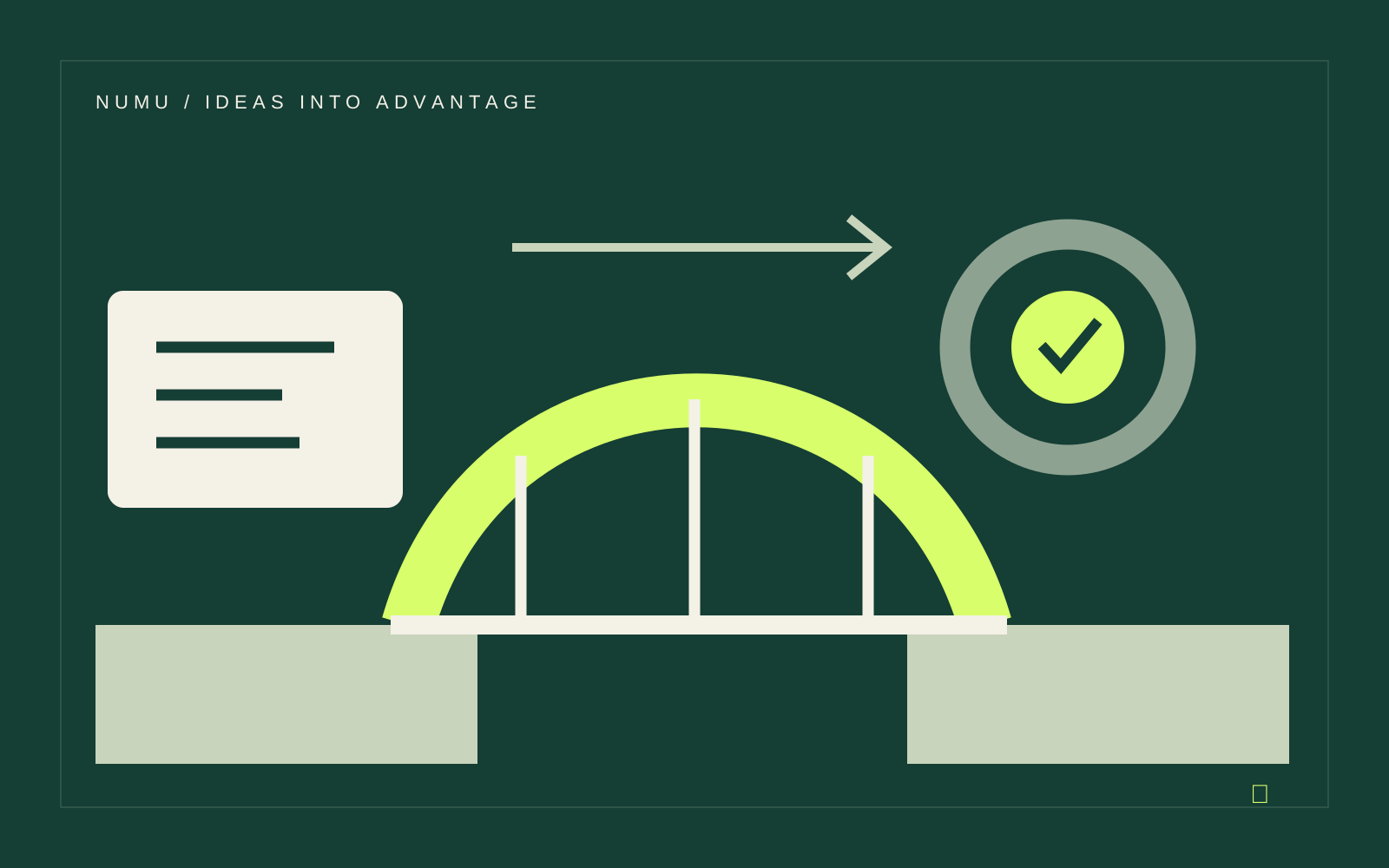
Sell a bounded learning engagement with controlled deliverables, a cost model and an explicit decision at the end.
Begin with the decision after the pilot
A pilot should help a buyer make a decision that is currently too uncertain. The decision could be whether a supplier can meet a specification, whether customers can complete an unfamiliar task, or whether a new content format answers a recurring question. GOV.UK’s guidance on alpha delivery describes using limited prototypes to test risky assumptions. A commercial pilot can borrow that learning logic without copying a government delivery process. Write the decision in one sentence. If the pilot succeeds, what might the buyer approve next? If it fails, which larger expense or operating commitment could be avoided?
Separate deliverables from business outcomes
Separate what the supplier can deliver from what depends on other people. Producing a researched guide, testing a form with recruited participants or delivering an agreed sample are controllable activities. Generating a fixed number of sales usually depends on demand, pricing, timing, distribution and the buyer’s follow-through as well. The proposal should name each deliverable and its acceptance method, then describe business outcomes as hypotheses to investigate. In a hypothetical marketing pilot, a revised enquiry page can be an agreed output while improved enquiry quality remains a question. This distinction lets both parties assess the work without pretending the market is controllable.
Build a transparent cost floor
Calculate the effort needed to do the experiment properly. Include preparation, access arrangements, delivery, analysis, project management and a closing review. Use actual internal rates where available and separate external purchases from staff time. An illustrative model might use 24 hours at an internal cost of 20 OMR per hour, plus 120 OMR of external inputs. Direct cost is then 600 OMR. A proposed fee of 900 OMR leaves 300 OMR before wider overhead, taxes and other excluded costs. These figures are an arithmetic example, not a market price, a recommended margin or a forecast of profit.
Price the unknowns through scope
Do not bury every unknown inside a large contingency. Instead, state the assumptions that control the workload: one location, a defined set of records, a named buyer contact, one consolidated review and a limited test period. Specify what happens if an assumption is wrong. Missing source data might pause the clock; an additional business unit might require a separate scope. A useful pilot can be smaller than the buyer’s original request if it answers the hardest question first. Explain the exclusion in terms of the decision being tested, so a narrow experiment does not look like an incomplete version of a large project.
Agree the evidence before starting
Agree which evidence will support the closing decision. Record the starting position, observation window, collection method and obvious limitations. A small trial may reveal a recurring obstacle without establishing how common it is across the whole market. If the buyer’s staff are meant to respond to enquiries, record their response process as part of the context. Changes elsewhere in the business can affect the result. Keep the delivery fee distinct from any optional success-linked arrangement, which needs its own precisely defined measurement and commercial review. Avoid an outcome payment tied to a number that neither party can reproduce.
End with a decision, not an automatic retainer
At the end, present the evidence beside the original question. Recommend one of three paths: proceed with a defined next stage, run a different test to resolve an important uncertainty, or stop. Explain what was learned even when the preferred idea did not work. Any ongoing engagement should have its own scope, economics and approval rather than becoming an implied obligation. A well-priced pilot earns its place by reducing a decision risk and showing how the team works. It does not need to promise a dramatic result. For a small supplier, this makes the first sale easier to explain and more responsible to deliver.
Sources & context
Official references checked 29 October 2026. Linked sources support the attributed statements; the working method is NUMU’s editorial synthesis.مراجع رسمية تم التحقق منها في ٢٩ أكتوبر ٢٠٢٦. تدعم المصادر العبارات المنسوبة إليها، أما المنهج العملي فهو معالجة تحريرية من نمو.